
The United States has a very complicated credit system, and it is virtually everywhere. In the center of the system is a credit report, which is basically your entire financial history. You may be stunned by the amount of details it contains about your daily activities involving finances and money.
Based on your credit report, a credit score is calculated to represent your "credit worthiness." Every lender - a credit card company, a mortgage lender or a bank - will almost certainly look at your credit score before granting you any type of loan or credit. The score will also directly impact how much interest you will be charged.
Needless to say, a credit score plays an important role in everyone's life. It is especially true for immigrants pursuing an American Dream, because many are not familiar with the credit concept before arriving in the U.S.
A credit score is a three-digital number that indicates your risk level in the eyes of a lender. A higher score means you will be more likely to pay back your debt. When you apply for a credit card, buy a house, lease a car, apply for a small business loan, set up utilities, or even rent an apartment, your credit score will be a key factor, among other things.
There are many types of credit scores available, but the dominant one that most lenders use is called Fico Score, developed by the Fair Isaac Company (now called FICO). A FICO score ranges from 300 to 850 and is calculated using a mathematical model based on a consumer's financial data, including but not limited to:
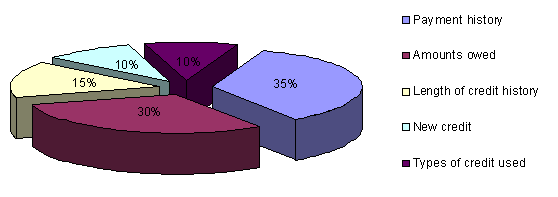
Here is a breakdown of how much impact each factor has on your fico score: your payment history (35%), utilization (30%), length of credit history (15%), new credit and recent inquiries (10%) and types of credit used (10%). Race, color, nationality, religion, sex and marital status are prohibited by US law from being included in calculating credit scores. Certain information, such as your age, job, salary, employment history, residence, etc. may be factored in some scores but not in others, and may be considered by lenders regardless of their presence in the scores.
You can purchase your Fico Scores/Reports from the FICO's official website at myFICO.com. Additionally, you can also buy your score from the three credit reporting companies: Equifax, Transunion or Experian. If you applied for a loan, the financial institution should send you a letter showing your credit score that was used in consideration of your application. Also, certain credit cards offer the benefit of monitoring your credit history including your score. Keep in mind that sometimes you will get a credit score based on a different model than FICO.
NextGen Score is a newer scoring model developed by FICO. All three credit reporting companies provide credit scores based on this model, but market them differently:
It is very common to see different credit scores from the three credit bureaus, even if they are all based on the same FICO scoring model. The fundamental reason is that their data on you are different: Each credit reporting company may set different policies on handling your information, such as low long they keep them in the database, and some businesses choose to report your information to some but not all three credit bureaus.
Another important reason is that credit bureaus may modify the scoring model by putting different weight on various factors. They may also change the scoring range. For example, one scoring model used by Experian ranges from 360 to 840, and another by Equifax offers scores from a low of 334 to a high of 818.
Fortunately, lenders usually look at your credit scores from multiple sources in order to more accurately evaluate your credit worthiness. Having said that, however, if you see your score from one credit bureau being significantly lower than others, you should contact them to correct any problems there may exist.
Yes. In fact, there are many. Credit bureaus and many financial institutions have their own scoring models, but they are in no position to rival FICO's dominance. The only real threat is VantageScore, co-developed by three major credit bureaus. However, it is still too new to gain significant market shares from FICO.
Yes. If you own a credit card you will definitely have a credit report, thus a credit score, whether you know it or not. Even without a credit card, your banking activities, payment to utilities bills, dealing with phone, internet or TV providers, may still be recorded.
There are some general tips to increase your FICO credit score:
See also: Credit Reports
