I live in a small community in San Diego and every year our town puts on a spectacular July 4th fireworks show. By spectacular, I didn’t mean it was comparable to New York or DC, but last night it was enough to cheer up the 25+ guests gathered in our backyard for an up-close, unobstructed view of the entire show. For a minute I was convinced the kids were making louder noises than the fireworks, but I decided to give them a break
I also took some photos; actually this was my first time trying to capture fireworks. The camera I used is a Canon Xsi, with an EF 24-105mm, f/4 L IS USM zoom lens. Manual focus to infinity, no flash, ISO100, f8 or f10, and on a tripod. I didn’t have a manual or remote release so I didn’t try the bulb mode, but I did take a few long exposure shots (4-6sec) and the results were better than I expected:
A while ago I talked about how to import and sync contacts with Gmail on an LG Optimus phone and it was a rather tedious process. Today I got a Google Galaxy Nexus HSPA+. Since it is a true “Google Phone” and came directly from Google, I wanted to see how easy it is to import contacts from my old SIM card and synchronize with my Gmail account.
In short, it is a very straightforward process, but not without hiccups.
First of all, the phone/call app doesn’t show any of my contacts on the SIM card. Instead, you have to work with the People app to find and import them. This may be a well-known fact for you guys who have had newer versions of Android, but it took me a little while to figure out.
Now that I know where my contacts are, the next step is to import them from the SIM card to the phone. The process is indeed simple:
- From the Home screen, open the People app;
- Touch Menu icon (the three little squares), then Import/Export;
- Touch Import from SIM card;
- I only had one Google account set up on the phone so it didn’t ask me to choose an account;
- To import contacts one at a time, touch them;
- To import all at once, touch Menu icon, then Import All.
But wait, where is the “Import All” option? In fact, I didn’t even see the menu icon after step 4. There is no way I was going to import all my contacts one by one, so I restarted the process, but with the same result. While searching for an answer online I tried a couple more times…and Bam! There it is! I don’t know if it is a bug in Android ICS 4.0 or the phone, but it appears that it takes a few tries to get the menu icon to show up. And after that it is smooth sailing and I was able to see all my contacts in Google right away.
The next step after accepting an application is to run a background check. These security checks typically include a fingerprint check, FBI name check and other fraud detection measures, and it all starts with a biometrics appointment.
On June 5, 2012 my online status indicated that USCIS has sent out the Biometrics Notification. On the 7th, I received it in the mail. It is a Form I-797C with a Code-3 appointment, scheduled for 6/25. Code-3 means I’ll have to provide all ten fingerprints and also take a digital photo.
I have a conflict next Monday. So I decided to try my luck and do a walk-in today. If rejected, I figured I could always re-schedule it then.
I arrived at the USCIS Application Support Center in San Marcos, CA just after 1pm. The office is located in a small shopping center just off Highway 78. When I got there the parking lot was quite full, so I was kind of expecting a big crowd. But to my surprise, there were only about five people waiting inside the room.
I handed my appointment notice to the officer at the front desk. He glanced over it and gave me a form to fill out, without asking any questions. He did remind me to turn off my cell phone, which I already left in my car.
It was a short questionnaire requesting some basic information, such as name, A-number, receipt number, DOB, citizenship, race, eye color, hair color, height and weight. In fact that was about it. It took me a couple minutes to finish the form, and the same officier verified the information against my appointment notice. He also asked to see my green card and driver’s license. The I-797 specifically said citizenship applicants must bring their green card, while other applicants only need to show their regular ID’s.
At this time I mentioned my original appointment was for next Monday but I couldn’t make it. He said no problem and gave me a ticket number along with a packet containing the biometrics notice, the questionnaire, my green card and driver’s license. He also gave me a printed booklet to study at home (M-638, Quick Civics Lessons for the Naturalization Test). In addition, he asked to see the front of my hands, apparently to check if there is anything that will interfere with collecting fingerprints.
I then sat down for just a couple minutes before my number was called.
Another officer/technician led me to a work station located in the same room. He scanned the two barcodes on the I-797 and manually typed in other information, including those I just put on the form. He then did a test run and said my fingerprints looked a bit light, so he started wiping my fingers as well as the scanner glass with a damped paper towel. Glad I didn’t eat pizza at lunch!
Once everything looked good he started the fingerprinting process, which was somewhat tedious: Four fingers on my left hand first, then left thumb, right four fingers, and finally right thumb. After that it was each finger individually, rolling from left to right while scanning. The next step was taking a digital photo. There was already a camera set up by the scanner so it was quick and easy. Finally, I signed my name on an electronic keypad. He double checked everything on the screen and told me it was done. I got the packet back (except for the questionnaire) and also filled out a short customer satisfaction survey.
So my walk-in biometrics appointment took about 15 mintues from start to finish – much better than I expected. The technician did mention that if I came in this morning I’d have to wait probably 30 – 50 minutes, so I guess it is YMMV (Your Mileage May Vary). I’m glad this step is now over, and we’ll see how long it takes for my background check to clear.
Update 8/17/2012: Received interview notice in the mail today with interview scheduled for 9/18. Strangely, my online USCIS case status never changed. Lately I’ve been anxiously checking my case status nearly every day, but it has been stuck on Initial Review since June 5. Oh well, I won’t complain.
Entire N-400 Citizenship Application Process:
- Step 1: Application
- Step 2: Acceptance
- Step 3: Fingerprinting (this post)
- Step 4: Interview
- Step 5: Oath Ceremony
The July 2012 Visa Bulletin was released today and the headline was the establishment of a cut-off date of 2009-01-01 for EB-2 ROW (all countries other than those listed separately). Although DOS has recently warned of potential retrogression for EB2 ROW, the backward movement of 3+ years still came as a surprise to many. After all, the EB2 ROW category has been “Current” for all but two months in the last decade!
The retrogression was obviously caused by heavy demand for visa numbers, but what caused such a high demand this year? My first guess would be EB3 to EB2 conversions, given that ROW EB3 has been hovering around a six-year wait which could give people enough motivation to make the switch. Unfortunately there is no government data on this subject so we can only guess. Of course, it could simply be that more people are applying for green cards, although I’m a bit skeptical given the state of the U.S. economy in recent years.
Now a brief recap of the July Visa Bulletin:
- EB1 remains current across the board;
- EB2 India and China remain “unavailable”;
- EB2 ROW, as well as Mexico and Philippines, moves back three years to 2009-01-01;
- EB3 moves forward by a few weeks for all categories;
- EB3-Other moves forward at its usual pace, with China finally starting to advance;
Today I went with a group of co-workers to volunteer at the Ronald McDonald House of San Diego. Our job was to cook and serve dinner to more than 100 people, so that they could “relax” and have a hot meal at the end of the day.
These families have one thing in common: They all have a child in the hospital being treated for a serious, often life-threatening illness. I can’t pretend to understand what they are going through, but I’m truly glad that I was able to offer a little help.
We spent about four hours at the Cafeteria. Started with cleaning the floor and setting up tables, went on to prepare food (short ribs, mashed potatoes, salad, drinks and cup cakes), and then served dinner to people waiting in line. Many kids were there at the dinner, and a few grandparents too. Some children, organized by a volunteer apparently, performed “Snow White” that was quite entertaining. It brought laughter from the otherwise quiet crowd.
Last step was to clean up and make the kitchen ready for breakfast tomorrow. The kitchen does have a few full-time staff – serving three meals a day isn’t trivial – but its daily operation depends largely on volunteering and donations. One of my co-workers asked what happens if they run out of donated food and grocery, and Chef K.C. replied that they would have to tap into their main budget to purchase only essential stuff and offer “low-cost” meals.
We also took a brief tour of the facility. Without knowing how a charity like this works, I was able to see how people’s generous donations were put into good use. Many families are stretched financially caring for children in medical crisis, so a place like the McDonald’s House that provides housing and meals would be a huge relief. Not only that, the San Diego charity is right across the street from the patients’ building. Parents can walk over in just a few minutes, and when they take a much needed break, they can be reached quickly if something happens. One of the two TV rooms has a window facing the kids rooms. When we were told that sometimes the very young children could see their parents through the window, realizing that they weren’t far away, I had to try hard to hold back my tears.
Another thing I learned was that although McDonald Corporation and local restaurants provide a steady source of funding, the vast majority of the San Diego charity’s annual budget come from individuals, foundations and other businesses. The event we just organized today was one example. Also, remember those little boxes at McDonald’s restaurants that people can drop their spare changes in? I’ll forever look at them differently now. Last year alone, those donation boxes collected nearly $25 million that will be distributed to individual McDonald Houses worldwide.
I was teaching my son how to play Chinese Chess the other day, but couldn’t remember the whole rhyming song that explains the basic rules. So today while driving home, I made one up
马走日
象走田
炮打须隔山
小卒步步向前走
大俥纵横无阻拦
双士护两侧
老将守家园
中国相棋乐无边
Sorry if you don’t read Chinese, and I don’t think I’ll be able to translate it either. But if you are interested (it is a fantastic game, by the way), Wikipedia actually has some instructions in English. There are also quite a few Chinese Chess apps for Android and iPad if you want try it out.
The 2012 solar eclipse came and went, and it sure was fun to watch. I tried the simple method using binoculars to project the sun’s image onto a white board, and it worked surprisingly well. Basically, I held a pair of binoculars and pointed the wide end at the sun (never look through the eyepiece directly!). On the other end I put a piece of white board on a lawn chair. Using my own shadow as the background, the eclipse was clearly projected to the board for safe viewing and picture taking. Below are a few images I took:
Another look later:
You can see the setup and the shadow of a dedicated dad, showing strong desire to teach his kids science, despite their little interest:
Although I felt lucky to be able to watch the eclipse unfold right in front of my eyes, these guys probably had a better view:
For truly amazing eclipse photos, of course, Google is your friend.
May 10, 2012:
According to the delivery confirmation from U.S. Post Office, my N-400 application package was delivered early this morning to USCIS (P.O. Box in Phoenix, AZ).
May 11, 2012:
USCIS accepted my application and entered it into their system (as I later found out from the email notification I received).
May 15, 2012:
I received an email from USCIS notifying me that my application has been received and a receipt number has been assigned to my case. USCIS sends out notices by email only if the applicant completed Form G-1145, E-Notification of Application/Petition, which is optional.
Dear Applicant/Petitioner:
Your USCIS application/petition has been received and routed to the National Benefits Center for processing. Within 7-10 days by standard mail you will receive your official Receipt Notice (Form I-797) with your Receipt Number NBC*00269xxxx. With the official Receipt Notice (Form I-797) you may visit www.uscis.gov where you can check the status of your application using My Case Status. We suggest you wait until you have received your Form I-797 before checking My Case Status.
In addition to the email, I also received a text message on my mobile phone with essentially the same but shorter notice:
USCIS: Your application was received. Receipt # NBC*00269xxxx. Official Receipt Notice (Form I-797) to follow in mail. Msg & Data rates may apply. NO NOT REPLY.
Even though I haven’t received Form I-797, I was able to check the status of my application online using the receipt number included in the email above. Surprisingly, my case status is already at the Initial Review stage (not Acceptance as I was expecting).
On May 11, 2012, we received this N400 APPLICATION FOR NATURALIZATION, and mailed you a notice describing how we will process your case. Please follow any instructions on this notice. You will be notified by mail when a decision is made, or if the office needs something from you…
During this step, USCIS initiates the background checks of the applicant/petitioner and identifies issues that may need to be addressed either during an interview or by asking the applicant/petitioner to submit additional information or documentation. USCIS reviews the applicant’s/petitioner’s criminal history, determines if there are national security concerns that need to be addressed, and reviews the application/petition for fraud indicators.
Also on May 15, 2012, my check for the payment of $680 was cashed.
May 17, 2012:
Received Form I-797 via regular mail. The notice contains three dates:
- Received Date: May 10, 2012
- Priority Date: May 10, 2012
- Notice Date: May 14, 2012
Entire N-400 Citizenship Application Process:
- Step 1: Application
- Step 2: Acceptance (this post)
- Step 3: Fingerprinting
- Step 4: Interview
- Step 5: Oath Ceremony
Today is the start of my journey to U.S. citizenship. I mailed my N-400 application to USCIS this morning, and will be blogging and recording each step along the way until the Naturalization Certificate arrives.
I will try to be as specific as possible, with hopefully enough details to help other DIYers. At a minimum, I would like to document the entire process so that people thinking about becoming a citizen have a live example to reference to. However, please keep in mind that your situation may be different from mine and adjustment in your application may be necessary.
Eligibility
First thing first, let’s check to see if I’m eligible to apply for citizenship, by going through the requirement list line by line:
- You are a lawful permanent resident (green card holder): Sure.
- You must be 18 years of age or older: I wish I had to think twice about this but yes, I met this requirement years ago! Oh well……time flies.
- You have resided in the US as a lawful permanent resident (LPR) for at least 5 years, with no single absence from the US of more than one year. Absence of more than 6 months may restart the clock of counting Continuous Residence: Check. I did leave the U.S. several times on business and personal trips, but none exceeded three weeks, so I’m good.
- You have been physically present in the US for at least half of the last 5 years (30 months): No problem. The total time I spent outside the U.S. in the last 5 years was less than two months, so I definitedly meet this requirement.
- You have resided within a state or district for at least 3 months: Yep, been calling California home for 10 years now.
- You must be a person of good moral character: I certainly think so
- You can read, write, speak and understand basic English: No problem.
- You have a basic knowledge of US history and government: Check (Note to myself: Go over the test questions before interview just in case).
- You must show attachment to the principles of the Constitution: Done.
So, it appears that I’m indeed eligible. Now the question is when to file an application.
Note that my case is based on permanent residence through employment, but there are other ways to become an LPR and their naturalization requirments may be slightly different. For example, if you obtained your green card through marriage to a U.S. citizen, you only have to wait 3 years instead of 5 to be eligible for citizenship. Also, members and veterans of the U.S. armed forces, as well as their dependents, may be eligible for citizenship and may even qualify for expedited processing.
When to file?
You can apply for naturalization at any time as long as you meet the requirements at the time of filing. But if you want to become a citizen as soon as possible, you need to figure out the earliest date you can submit your N-400. USCIS will reject your application if you file too early.
You may submit Form N-400 up to 90 calendar days before your 5th (or 3rd if marriage-based) anniversary of becoming a permanent resident. For example, if your green card says “August 1, 2007,” you meet the 5-year permanent residence requirement on “August 1, 2012.” The earliest date you can apply for naturalization would then be May 3, 2012.
I’ve built a date calculator that can be used for this purpose. All you have to do is to select your anniversary date, and subtract 90 days (not 3 months) from it to get your early filing date.
The USCIS considers an application “filed” when they receive the package, and they don’t go by postmarks. So if you are in an absolute hurry, and want to make sure your application is received on exactly May 3rd as in the example above, you can actually mail it on the 2nd if you choose Next-Day courier service. If you use regular mail you have no control over when your application will be delivered, so the risk of filing too early would be higher. If possible, give it a few days of cushion just to be safe.
Form N-400
The Form N-400 is fairly straightforward. It took me less than half an hour from start to finish. One thing that helped was my habbit of scanning all immigration related documents, making it easy to search for information. My scanned old passport, for example, allowed me to quickly figure out the exact dates I was outside the country.
USCIS has the form, instructions, eligibility worksheet, and document checklist on their website for free download.
Form N-400 requires the following information, and some of them , if applicable to you, may need extra time to gather:
- Part 1: Your Name and A-Number, including opportunity to change your legal name
- Part 2: Your Eligibility
- Part 3: Personal Information: SSN, DOB, Date of Becoming Permanent Resident, Current citizenship, Marital Status, Waiver Requests, etc.
- Part 4: Address and Phone Number
- Part 5: Information for Criminal Records Search: Gender, Height, Race, etc.
- Part 6, Residence and Employment History for the Last Five Years
- Part 7: Time Outside the U.S. including Exact Dates for Each Trip
- Part 8: Marital History (including Current Spouse’s Marital History)
- Part 9: Information about Your Children
- Part 10: Long List of Yes/No Questions
- Part 11, Your Signature
- Part 12: Signature of Person Who Prepared the Form for You
- Part 13: Signature at Interview (Don’t Sign Yet!)
- Part 14: Signature for Oath of Allegiance (Don’t Sign Yet!)
Application Package
My naturalization application package included only five items:
- Form N-400
- Copy of both sides of my green card
- Personal Check for Payment of $680 ( = $595 + $85)
- Two Passport-Style Photos
- Form G-1145 for Electronic Notification (Optional)
Photos
The photo requirements for naturalization are the same as other immigration related applications. You can get them at any place that offers passport photo services, such as the Post Office, Costco, CVS, or even online. However, it is also quite easy to do it yourself with a digital camera and an inkjet printer.
I did mine at home: Stood against a white wall, made sure the lighting was good to avoid shadows, used a tripod, and took a bunch of pictures. Then I simply picked the best (looking) one and used the State Department’s online photo tool to crop it. Finally I printed two photos on glossy media using an all-in-one printer. The hardest task was actually cutting out the 2″x2″ photo and I used a precision knife and a metal ruler to do the job (and it worked out just fine). My camera is a DSLR, but even point-and-shoot cameras in recent years should have sufficient resolution and image quality for this purpose. Cell phone cameras shouldn’t be used, however. The State Department has a resource center offering extensive information on passport photos, including the photo tool I just mentioned.
After all the work, the photos you submitted are probably useless. USCIS will most likely take your photo during your biometric appointment and use the digital image instead. But since they still require actual photos, we’ll have to submit them.
Good enough for now. I’ll update whenever there is a status change.
Entire N-400 Citizenship Application Process:
- Step 1: Application (this post)
- Step 2: Acceptance
- Step 3: Fingerprinting
- Step 4: Interview
- Step 5: Oath Ceremony
USCIS began accepting new H-1B petitions on April 2, 2012. If approved, beneficiaries of these petitions may start working in H-1B status on or after October 1, 2012 – the first day of FY 2013 cap season. The following table includes every cap count released by USCIS. The table will be updated on a regular basis to show the pattern of this year’s H1B filing.
The first count, conducted on April 9, 2012 is about three times more than last year’s. If this turns out to be a trend, H-1B visas could be exhausted much faster than last year, during which the regular cap was reached on November 22, 2011.
On June 12, 2012 USCIS announced that they have received a sufficient number of petitions to reach the regular H-1B cap for FY 2013 as of June 11, 2012. In addition, USCIS received more than 20,000 H-1B petitions against the advanced degree cap on June 7, 2012. USCIS will reject petitions subject to the FY-2013 cap for H-1B specialty occupation workers that are received after June 11, 2012. USCIS will continue to accept petitions not subject to the annual cap.
| Date of Last Count | Regular Cap (65,000) |
Advanced Degree Exemption (20,000) |
| 4/9/2012 | 17,400 | 8,200 |
| 4/13/2012 | 20,600 | 9,700 |
| 4/20/2012 | 25,000 | 10,900 |
| 4/27/2012 | 29,200 | 12,300 |
| 5/4/2012 | 32,500 | 13,700 |
| 05/11/2012 | 36,700 | 14,800 |
| 05/18/2012 | 42,000 | 16,000 |
| 05/25/2012 | 48,400 | 17,500 |
| 06/01/2012 | 55,600 | 18,700 |
| 06/11/2012 | 65,000 | 20,000 |
The graph below will be updated regularly to show H-1B visa filings for FY-2013:
Below is last year’s H-1B cap count (FY 2012) for reference:
Over the past ten years, my parents have visited us six or seven times. Every time they fly between China and the U.S., however, my anxiety level would skyrocket for the duration of their entire trip. I keep telling myself they’ve done it so many times without a glitch, but mentally just can’t help it. I guess the fact that they are getting older, and less mobile, every time I see them is a good enough reason to be concerned. And on top of that their English skill (Ok, they don’t speak any) doesn’t help either.
I know I’m not the only one, though. In fact all my friends face more or less the same problems. So I’ve been thinking about posting some easy-to-follow travel guides on immigrationroad.com to hopefully make their cross-ocean journey less stressful. I already did the first one: A list of English/Chinese translations of frequently used terms around an airport, on board an airplane, and going through Customs inspections. If it turns out useful, I’ll add more content and maybe even have it translated into other languages as well.
Other than translations, I also did a few things that may have helped my parents previously. I’ll list some of them in case you haven’t thought about them:
- Fill out a sample Form I-94 so that they can simply copy all the information while completing the real I-94 card during a flight;
- Explain and translate all items on the Customs Declaration Form as well;
- Have them carry a card with your phone numbers in case of emergency;
- If they have medical conditions, have them carry a brief description (in English) with them at all times;
- Book non-stop flights if at all possible. It is easy to imagine how struggling they will be to catch a connection flight at a foreign airport, not to mention a potential delay or cancellation. I know some of you live too far from a major airport, and direct flight isn’t an option; what I meant was that if you do have a choice, even if the ticket may cost a bit more or you have to drive farther to pick them up, a non-stop flight should really be on top of your priority list.
- Send them a detailed airport map and instructions if they do have to deal with connection flights;
- Have them bring a copy of the entire itinerary with them so that airport staff may be able to help without a translator;
- Although most airlines flying to and from China will have Chinese-speaking attendants, it is not guaranteed. If this is important (they need special assistance, for example), then obviously China-based airlines would be better options. Air China and China Eastern sometimes have Chinese-speaking staff at the airport to help passengers going through Customs inspection, which is very important for first-time visitors.
If you have other tips or materials that you would like to share, please drop me a line.
Updated 4/1/2012: Added Airport Inspection Process in Simplified Chinese (and English)
A prediction from Charles Oppenheim about EB-2 retrogression has sent a shock wave among I-485 applicants, likely prompting a protest against the much easier venue classified as EB1-C for international managers.
Mr. Oppenheim, Chief of the Visa Control and Reporting Division at the Department of State, announced at the AILA Midwest Regional Conference on March 16 that EB-2 priority dates for India and China could potentially retrogress all the way back to August 2007! Any this may happen during either the May or June 2012 Visa Bulletin.
His prediction, always considered trustworthy given his position, caused widespread frustration among EB-2 filers. It seemed particularly disappointing because the category’s cutoff dates have been advancing rapidly for months. However, many people were kind of expecting the bad news, since Mr. Oppenheim did warn about potential retrogression at some point this year. So it was his other prediction that appeared to be hurting: No EB1 spillover to EB2 this year.
A visa “spill-over” means that unused visa numbers for a given EB preference are re-allocated to the next category. In recent years, spillover from EB-1 has helped the EB-2 category tremendously. But Mr. Oppenheim believes that all EB-1 visa numbers will be consumed within the category this year. On top of that, due to the government’s heavy promotion of investor visas, the EB-5 category will likely exhaust their allotment as well.
So all of these have painted a bleak future for EB-2 for the remainder of FY-2012. Coincidentally, there is now a petition proposing a thorough investigation into EB-1C, reserved for multinational managers or executives. A group has set up a petition to Congress: Stop EB1 C ABUSE and FRAUDULENT filing. Here is what the petition says:
We would like to appraise you of a particular area of United States Immigration law that has a huge potential of fraud and misrepresentation along with being unfairly biased in favor of the people who choose to abuse it. We are talking about the Employment-based first preference category EB1C (International Managers). As you are already probably aware, the requirements for eligibility in that category is just a year of overseas managerial experience in a company that conducts business in both US and abroad. We are sure you will agree that compared to the fair and stringent requirements of EB1A (persons of exceptional ability) and EB1B (outstanding researchers), this is a rather simple qualification to prove. Moreover it opens up avenues for fraud and misrepresentation particularly by overseas companies doing business in USA to unfairly take advantage of this simple requirement.
In some cases, a journey from L1 visa to EB1C green card does appear to be much shorter, compared to those who studied in the U.S. for a degree and then had to wait many years for their EB2 or EB3 green cards. On the other hand, there are indeed people who worked really hard overseas, climbed up the ranks, and eventually got transferred to the States as managers. So I hope the petition, if fruitful, will help block the loopholes where (staffing) companies simply assign manager titles to people for the purpose of gaining an advantage in immigration, rather than closing the door for legitimate candidates.
The Department of State today released the Visa Bulletin for April, 2012. The rapid forward movement of EB-2 in recent months has unfortunately come to a stop. Cutoff dates for both China and India EB2 categories remained the same as March: May 1, 2010. The Visa Office warned about potential slow down or even retrogression of cutoff dates in January, and today it became reality.
Visa bulletins are used to regulate the allocation of visa numbers. When demand goes up, cutoff dates may have to be moved back to prevent accidental over-consumption of visas. On the other hand, if demand level is low and there is a possibility of having unused visa numbers in the end, cutoff dates will be advanced accordingly to avoid wasting any. So there is still a chance that BE-2 will move forward again, and if it does, it will probably happen around July time frame. In addition, if there is visa spill-over, meaning that unused EB-1 visa numbers are being passed down to EB-2, we might see another jump in the Summer.
Below is China EB2 visa bulletin movement so far for fiscal year 2012 (India EB2 is the same for this period):
| VB Year | VB Month | Cut-Off Date (Y-M-D) | Movement (days) | Wait Time (days) |
| 2012 | 4 | 2010-05-01 | 0 | 701 |
| 2012 | 3 | 2010-05-01 | 120 | 670 |
| 2012 | 2 | 2010-01-01 | 365 | 761 |
| 2012 | 1 | 2009-01-01 | 292 | 1095 |
| 2011 | 12 | 2008-03-15 | 135 | 1356 |
| 2011 | 11 | 2007-11-01 | 109 | 1461 |
| 2011 | 10 | 2007-07-15 | 91 | 1539 |
All EB-1 categories, as well as all EB-2 other than India and China, remain current. This means that anyone who belongs to one of these classifications is eligible to file new I-485, and if they already did, their applications are eligible for approval.
All EB-3 categories are still heavily backlogged, while moving at an extremely slow pace from month to month. Here is an comparison for April:
| EB-3 | Visa Bulletin | Cut-Off Date (Y-M-D) | Movement (days) | Wait Time (days) |
| ROW | April 2012 | 2006-04-08 | 24 | 2185 |
| China | April 2012 | 2005-03-01 | 59 | 2588 |
| India | April 2012 | 2002-09-01 | 10 | 3500 |
| Mexico | April 2012 | 2006-04-08 | 24 | 2185 |
| Philippines | April 2012 | 2006-04-08 | 24 | 2185 |
Interestingly, as of late Friday night, the Department of State hasn’t updated their Website to show the April 2012 Visa Bulletin. However, the PDF version was posted earlier today and the voice recording (202-663-1541) has been updated with new cutoff dates for April. So the visa bulletin is indeed official, but it appears that someone at the Visa Office simply forgot to update the visa bulletin page before leaving for the weekend.
When submitting an immigration related application, you must have all foreign language documents translated into English. You don’t have to hire a professional translator to do the job, however. In fact, the translation can be provided by anyone who is fluent in both English and the foreign language. The United States Citizenship and Immigration Services (USCIS) does not judge or determine the translator’s qualifications, but does require a Certification of Translation attached to the document being translated.
There is no formal template for a Certification of Translator. However, the translator (you or someone else) must certify that s/he is competent to translate the foreign language into English, and that the translation is accurate to the best of his or her abilities. The certification should also include the person’s name, address, signature and date of translation.
Below is an example preferred by the USCIS:
Certification by Translator
I, ____________________________ [typed name], certify that I am fluent (conversant)
in the English and ____________ languages, and that the above/attached document is an
accurate translation of the document attached entitled ______________________________.
Signature________________________________ Date_________
Typed Name__________________________________________
Address______________________________________________
This is another sample, provided by the Immigration Court:
CERTIFICATE OF TRANSLATION
I, __________________________, am competent to translate from
(name of translator)_______________________________ into English, and certify that the translation of
(language)_________________________________________________________________
(names of documents)is true and accurate to the best of my abilities.
_________________________________ _________________________________
(signature of translator) (typed/printed name of translator)___________________________________________________________________________________________
(address of translator)___________________________________________________________________________________________
(address of translator)_________________________________
(telephone number of translator)
Question 1: Can I, as a petitioner, translate my own documents?
I’ve seen articles on the Internet stating that a petitioner or beneficiary of an immigration application/petition cannot translate their own documents. However, I have not been able to find any official statement from any government authority supporting that claim. So I’m not sure. If anyone can point me to the correct source, I would highly appreciate it.
In any case, you don’t necessarily have to use a professional translator. Anyone who is competent can translate the document(s) and certify them.
Keep in mind that what we are discussing here is about translating documents for immigration purposes. It is different than acting as an interpreter during an immigration interview. In that case, I know a petitioner is not allowed to be an interpreter for his/her relative during interviews.
Question 2. Do I still have to submit my documents in foreign language if I already have them translated?
Yes, the English translations are required to accompany those documents in a foreign language, not replacing them.
Question 3. Must each document have its own certification for translation?
Each document not in English must have a translation attached, but if you have multiple documents in the same foreign language in the same package, my personal opinion is that you can include one certificate of translator listing all documents translated and certified by the same person. However, if you choose to attach a certificate to each document (in addition to the English translation), it is certainly acceptable too.
Question 4. Do I need to have the translations notarized too?
Notarization of the translations is not officially required, but obviously won’t hurt. I personally wouldn’t do it, but if you’re extra cautious, go for it.
Question 5. Can I use a computer or Website-based automatic translating service?
I wouldn’t recommend it. Although you can use them, such as Google Translate, for certain words, you really don’t want to rely on them for translating an entire paragraph or even a full sentence. As a minimum, you need to double check and verify its accuracy before using it as your translation. Your birth certificate, marriage certificate, degree certificate, etc. are all important documents supporting your application, and you want to make sure they are translated completely and correctly. If you don’t feel comfortable, you should consider hiring a translating service to do it for you.
Question 6. Should I follow the same format of the original document while doing translation?
Yes, absolutely. Your translation must resemble the original document in layout and general formatting.
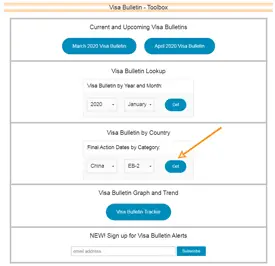
Today we added another feature to our Visa Bulletin Toolbox: Instead of reading visa bulletins by month, you will be able to select just your category and see years of cutoff dates all on one page, plus month-to-month movement and your overall wait time. Both employment-based and family-sponsored categories are included, covering every visa bulletin released since 2002. That is 10 years worth of data at your finger tip.
Although visa number consumption is carefully regulated by the Department of State, there are occasional hiccups, or even big mess up sometimes, like the one in 2007. You can spot those patterns and sudden changes easily with the new table format. Visa allocation is dependent on demand data, which always fluctuates making it difficult to predict next month’s bulletin. But over a longer period of time the overall trend stays relatively stable. The retrogression tracker has a graph showing this effect for EB2 and EB3 only, but the new data tables cover all categories and all countries. Here is an example for India EB2′s Cutoff Dates:
| VB Year | VB Month | Cut-Off Date (Y-M-D) | Movement (days) | Wait Time (days) |
| 2012 | 3 | 2010-05-01 | 120 | 670 |
| 2012 | 2 | 2010-01-01 | 365 | 761 |
| 2012 | 1 | 2009-01-01 | 292 | 1095 |
| 2011 | 12 | 2008-03-15 | 135 | 1356 |
| 2011 | 11 | 2007-11-01 | 109 | 1461 |
| 2011 | 10 | 2007-07-15 | 91 | 1539 |
| 2011 | 9 | 2007-04-15 | 0 | 1600 |
| 2011 | 8 | 2007-04-15 | 38 | 1569 |
| 2011 | 7 | 2007-03-08 | 144 | 1576 |
| 2011 | 6 | 2006-10-15 | 106 | 1690 |
| 2011 | 5 | 2006-07-01 | 54 | 1765 |
| 2011 | 4 | 2006-05-08 | 0 | 1789 |
| 2011 | 3 | 2006-05-08 | 0 | 1758 |
| 2011 | 2 | 2006-05-08 | 0 | 1730 |
| 2011 | 1 | 2006-05-08 | 0 | 1699 |
| 2010 | 12 | 2006-05-08 | 0 | 1668 |
| 2010 | 11 | 2006-05-08 | 0 | 1638 |
| 2010 | 10 | 2006-05-08 | 0 | 1607 |
| 2010 | 9 | 2006-05-08 | 68 | 1577 |
| 2010 | 8 | 2006-03-01 | 151 | 1614 |
| 2010 | 7 | 2005-10-01 | 242 | 1734 |
| 2010 | 6 | 2005-02-01 | 0 | 1946 |
| 2010 | 5 | 2005-02-01 | 0 | 1915 |
| 2010 | 4 | 2005-02-01 | 0 | 1885 |
| 2010 | 3 | 2005-02-01 | 10 | 1854 |
| 2010 | 2 | 22JAN05 | — | — |
| 2010 | 1 | 22JAN05 | — | — |
| 2009 | 12 | 2005-01-22 | 0 | 1774 |
| 2009 | 11 | 2005-01-22 | 0 | 1744 |
| 2009 | 10 | 2005-01-22 | 14 | 1713 |
| 2009 | 9 | 2005-01-08 | 465 | 1697 |
| 2009 | 8 | 2003-10-01 | 1369 | 2131 |
| 2009 | 7 | 2000-01-01 | 0 | 3469 |
| 2009 | 6 | 2000-01-01 | 1506 | 3439 |
| 2009 | 5 | 2004-02-15 | 0 | 1902 |
| 2009 | 4 | 2004-02-15 | 0 | 1872 |
| 2009 | 3 | 2004-02-15 | 45 | 1841 |
| 2009 | 2 | 2004-01-01 | 184 | 1858 |
| 2009 | 1 | 2003-07-01 | 30 | 2011 |
| 2008 | 12 | 2003-06-01 | 0 | 2010 |
| 2008 | 11 | 2003-06-01 | 61 | 1980 |
| 2008 | 10 | 2003-04-01 | 1218 | 2010 |
| 2008 | 9 | 2006-08-01 | 61 | 762 |
| 2008 | 8 | 2006-06-01 | 791 | 792 |
| 2008 | 7 | 2004-04-01 | 0 | 1552 |
| 2008 | 6 | 2004-04-01 | 91 | 1522 |
| 2008 | 5 | 2004-01-01 | 31 | 1582 |
| 2008 | 4 | 2003-12-01 | — | 1583 |
| 2008 | 3 | U | Unavailable | Unavailable |
| 2008 | 2 | U | Unavailable | Unavailable |
| 2008 | 1 | 2000-01-01 | 731 | 2922 |
| 2007 | 12 | 2002-01-01 | 821 | 2160 |
| 2007 | 11 | 2004-04-01 | 0 | 1309 |
| 2007 | 10 | 2004-04-01 | 0 | 1278 |
| 2007 | 9 | 2004-04-01 | — | 1248 |
| 2007 | 8 | U | Unavailable | Unavailable |
| 2007 | 7 | C | Current | Current |
| 2007 | 6 | 2004-04-01 | 449 | 1156 |
| 2007 | 5 | 2003-01-08 | 0 | 1574 |
| 2007 | 4 | 2003-01-08 | 0 | 1544 |
| 2007 | 3 | 2003-01-08 | 0 | 1513 |
| 2007 | 2 | 2003-01-08 | 0 | 1485 |
| 2007 | 1 | 2003-01-08 | 0 | 1454 |


Recent Comments